
Tracing My Creole Roots: An Ancestry Story from the LeBleu Settlement - Part I.
by Terry a. O'Neal | February 3, 2026
The search for my maternal grandfather’s people keeps returning to the same ground in Chloe and Iowa, Louisiana: land once known, and still referred to, as LeBleu Settlement, even though it no longer exists as it once did. I follow records forward and end up back there again.
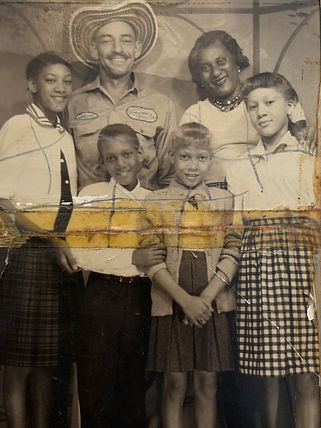
I come from the LeBleu family. For generations, the LeBleus and the Bowmans lived on the same land and on parcels that touched. My family lived and worked on the rice farm. Life overlapped. Some relationships were understood, while others went unspoken.
That closeness carried into the lives that came after, including that of my grandfather, George Lee Tillman. He grew up in the company among people who knew each other well. From the beginning, his life took shape around what was shared and what was hushed by racial divides and expectation.
Eventually, my grandfather left Chloe behind. As a young man, he moved through nearby towns, like Kinder and Lake Charles, building a life beyond where he had been raised. He even made his way to California for a period of time. In the mid-1930s, he married my grandmother, Leona Young. As life carried them along, their family grew. Together they would have ten children.
His return to the settlement came much later, in 1960. And for one reason only.
Cornelia Hunt, referred to as Grandma Nealy and was George’s maternal grandmother, raised him after his mother’s death. When Grandma Nealy’s health began to fail, George brought his family back to LeBleu Settlement to care for her.
Cornelia’s story reaches further back than most of the ancestry records that name her.
Her parents were James and Josephine Roberts Alphonse, my 3rd great grandparents. (Josphine is also known as Josephine LeBleu Alphonse.)
According to years of research and the 1910 census, they raised eighteen children together on LeBleu Settlement, Cornelia among them. (1910 United States Federal Census, Ancestry.com)
It was a large family, rooted to the same dirt, where work was constant and survival depended on everyone pulling together.
James Alphonse had been enslaved by Major J. C. LeBleu. When his death was recorded in the American Press, he was described simply as the last enslaved man held by the LeBleu family. (American Press, July 1943)
The notice mentioned that he had lived long enough to see four generations follow him and that he was buried in the Negro cemetery in Chloe. Research has revealed that this cemetery was formally known as Chloe Cemetery is now recorded as Saint Mary Cemetery, according to the Calcasieu Parish Assessor. (2026)
The obituary of my great-great-grandfather was brief, but his life was not. He was ninety-four years old when he died.
That was the world Cornelia was born into. Slavery had ended, but the ways it shaped daily life for colored people remained. Sharecropping, vagrancy laws, convict leasing, forced labor, and the constant use of fear to keep people in place were systems that became new ways of reshaping slavery. Families continued to live where they had always lived. Labor still followed the same lines and names still mattered.
My great-great grandmother, Cornelia, was listed in some records as Colored and others as Mulatto.
For decades, from about 1850 into the early twentieth century, census takers across the United States used that term to classify people of mixed African and European ancestry. It was an attempt to place people into categories that made sense to the racial order of the time.
In Louisiana, identity rarely fit neatly into those boxes. The region’s history under French and Spanish rule had produced a long-established community of free people of color, some of whom owned land, ran businesses, and lived in a social space that existed uneasily between white and enslaved Black communities.
Within slavery itself, skin color sometimes carried economic consequences. Light-skinned enslaved people of mixed ancestry were often assigned to domestic or skilled labor rather than field work and were sometimes valued more highly in slave markets. These distinctions were not privileges so much as reflections of the deeply racist system that measured human lives according to proximity to whiteness.
Terms like mulatto appeared in census records as if they were neutral descriptions. In reality, they were tools used to sort people, enforce hierarchy, and maintain the racial order that slavery and its aftermath depended upon.
The records, though sometimes not always accurate, reveal certain Creole and French surnames tied to free and mixed-status families that continue showing up in Calcasieu Parish—names, such as LeBleu or LeBleux, Arseneaux or Arsenaux, Guidry, and Fontenot, to name a few. These are names that appear in my own family lineage. Of course, tracing them always requires careful cross-checking, but their repetition feels more than simply incidental.
Still, the written record can only tell part of the story. In many cases, the clearest picture comes from the people who lived closest to it. My mother, along with my uncles and aunts, often described Grandma Nealy as having a white complexion with long straight hair in her later years. Those memories, passed down through family conversations, sit alongside the documents that serve as reminders of how history is not preserved only in archives, but also in the recollections of our family--those who knew them.
End of Part I
Comments